An epic survival story in the heroic age of polar exploration
Ernest Shackleton's misadventure is fetishized by many as an exemplar of remarkable leadership against overwhelming odds. But is it?

Men wanted for hazardous journey. Low wages, bitter cold, long hours of complete darkness. Safe return doubtful. Honour and recognition in event of success. (Shackleton recruitment ad, probably apocryphal.)
It’s universally acclaimed to be one of the great survival stories of all time: Ernest Shackleton’s Imperial Trans-Antarctic Expedition of 1914 to 1916. It exhibits the finest qualities of leadership, courage, and grit in a heroic age. But what about common sense and good judgment?
Shackleton’s plan was to traverse the Antarctic continent, on foot with skis and dogs. Britain had already lost the race for the South Pole to Norway. A veteran polar explorer, Shackleton recruited 28 men for the exploit and set sail from London as World War 1 began, on August 1, 1914. Many of the men were not well-suited to the mission, had little or no long-duration sea or ice experience, and one even suffered from extreme sensitivity to the cold.
When reaching the remote southern Atlantic island of South Georgia, in December (midsummer), the local whalers warned Shackleton that the ice pack in the Weddell Sea was much denser than usual and advised him to wait till the following year. He ignored their advice, and the Endurance - one of the sturdiest wooden sailing ships ever built (a three-masted barquentine custom-made by Norwegian shipbuilders) - edged further south despite the thickening sea ice.
Within a couple of weeks, in January 1915, it became beset, completely ice-bound, in the Weddell Sea, near Vahsel Bay, a few miles from the Antarctic mainland. The expedition would never even set foot upon it.
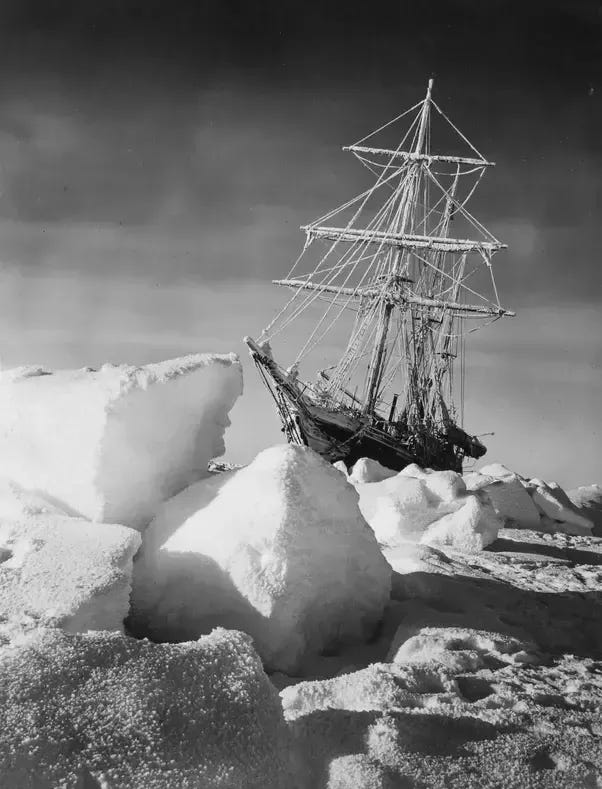
The ice-bound Endurance
The crew stayed aboard the trapped ship through the entire Antarctic winter - occupying themselves through the months of darkness with their routine of maintaining the ship, playing games, singing, smoking, and performing silly skits to each other.
They did not abandon their home till October 27th, when it was about to be crushed by massive ice floes that had enveloped the ship. They experienced the full shock of the elements, beginning with a futile three-day march over the ice to establish a temporary camp, which was interrupted by a mad rush to recover more provisions from the ship before it went down.
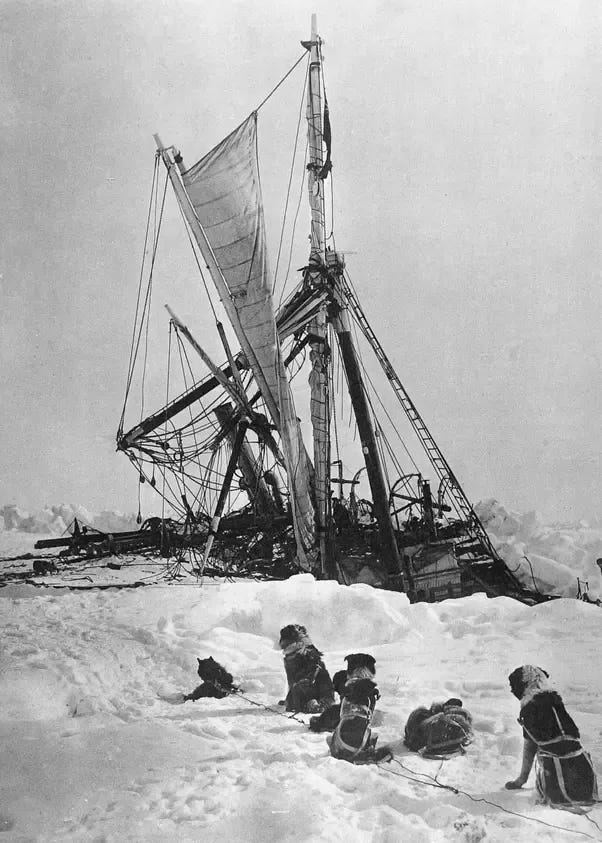
Dogs watching the end of the Endurance
The crew then embarked on a march to open water, an arduous journey of two months that required hauling three heavy lifeboats and all the equipment taken off the ship. On December 23rd, Shackleton abandoned the effort. They would make camp and wait for the late summer melt of the ice floes that surrounded them.
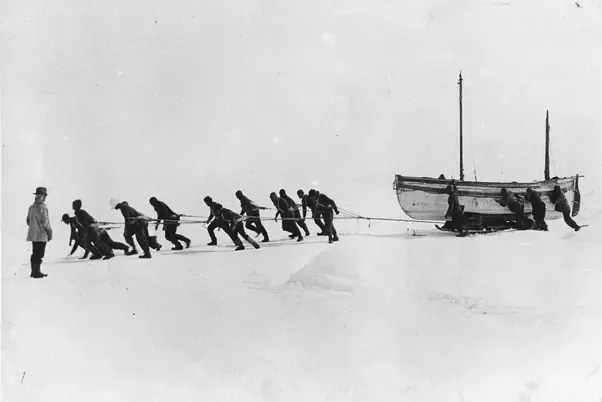
Hauling one of the three lifeboats
What Shakelton hadn’t bargained for was the rate and direction of the rotating ice mass in the Weddell sea, which made his originally preferred island destinations impossible. (One was Paulet Island, where 12 years earlier he had stashed a substantial amount of food for another expedition.)
By March 30, 1916 all 69 dogs and the ship’s cat had been killed for food. The ice floe they were camped on split in two, separating them from their three lifeboats. Even as they were circled by “killer whales” (orcas), they were able to recover the boats. In an act of desperation, on April 9th, the whole crew went to sea in the three lifeboats in a quest for one of the most inhospitable islands in the world: Elephant Island. It was a 200-mile, weeklong voyage in open boats over treacherous waters to reach a tiny speck. If they missed it, they would die in the open ocean.
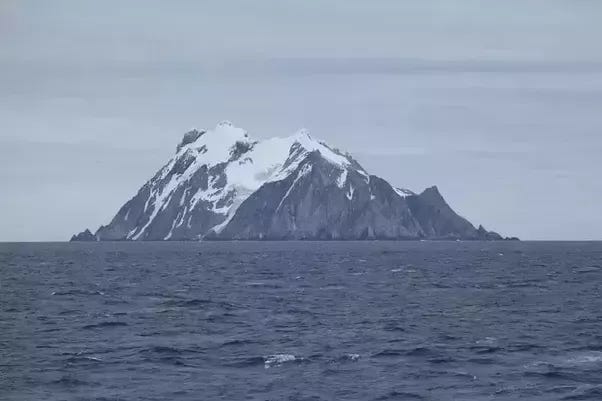
Elephant Island
They survived the journey, but the island had nothing to offer but steep rocky ledges. At least it was solid ground - the first the men had stood on for 497 days, since the expedition had departed South Georgia. They found the one spot on the island that afforded some shelter and hunkered down for the southern winter (just north of the Antarctic circle). Within days Shackleton announced he would leave and attempt to sail to the distant South Georgia.
Shackleton and five men left with the largest lifeboat, which the carpenter had made more seaworthy by raising the boat’s sides and building an improvised deck. They set out for a hellish 17-day voyage of 800 nautical miles with treacherous conditions and navigation against adverse winds and currents. Storms drove them ashore on the wrong side of South Georgia.
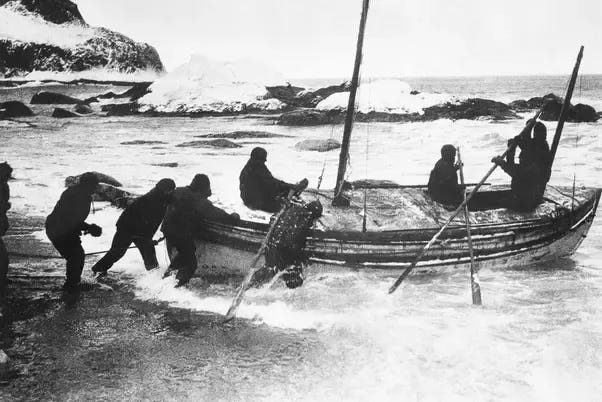
The lifeboat launch from Elephant Island
Shackleton decided their boat could not circumnavigate the island to the whaling station. Instead, he and two others set out by foot on something like a suicide mission to cross the never-charted and mountainous interior of the island: a 26-mile trek over icy peaks. Against the odds, they completed the journey in 36 hours with life and limb intact - and without sleep, which would have probably killed them due to extreme exposure. They each recounted a feeling of having an invisible guide.
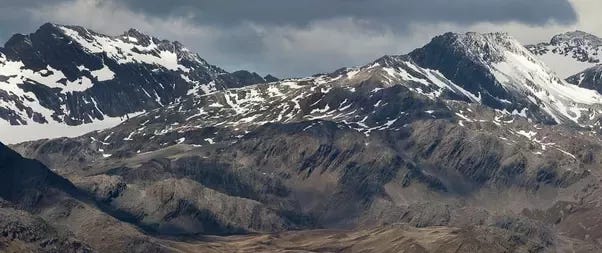
The peaks of South Georgia Island
As they drew close to the tiny whaling station, they heard a steam whistle blow, and completed their journey, but not before contending with a hazardous frozen waterfall. They were greeted with amazement by the inhabitants. Soon afterwards, the three who had been left behind were rescued.
What about the 23 men on Elephant Island? They were still there and alive despite frostbite and minor amputations by the crew’s medic. They were able to sustain themselves and keep warm - thanks to the abundant supply of unfortunate seals who could be bludgeoned on the rocky shore. This supplied adequate meat and blubber for fires. But Shackleton had no idea whether or not his men were alive.
After recovering for three days, on May 30th, he chartered a British ship to go to Elephant Island, but it was stopped by ice 100 miles short of the island. The Uruguay government loaned a survey ship, which came within sight of Elephant Island before pack ice drove it back. Independently, a British chartered schooner set out from Punta Arenas, Chile. It got within 100 miles of Elephant Island before storms and ice forced it to return.
On August 25th, Chilean authorities loaned a small steamer, which set sail to the island with Shakleton aboard. The Elephant Island survivors spotted the ship and signaled her with a huge blubber fire. The men were rescued after 131 days on the frigid island. Every member of the crew had survived.
However, that’s not the complete story. Unfortunately, there’s another one, far less known, of the support expedition on the other side of Antarctica that had been waiting for the arrival of Shackleton’s party for two years.
Oblivious to the fate of the Endurance, Shackleton's second team had anchored in the Ross Sea and had cached more than 4,000 pounds of provisions on the Ross Ice Shelf to supply Shackleton’s polar trek. They didn’t learn of the futility of their heroic efforts under terrible conditions until 14 months later, long after Shackleton rescued his crew. The Ross Sea Party had marched 1,500 miles to accomplish the only successful part of the Imperial Trans-Antarctic Expedition. The cost: Three lives including the team’s leader.
That’s the history. Now you decide: Greatest survival story or Epic Fail?
Note: The expedition was photographed in exquisite detail by crew member Frank Hurley, an Australian photographer. They are officially available, with difficulty, at the National Library of Australia.